
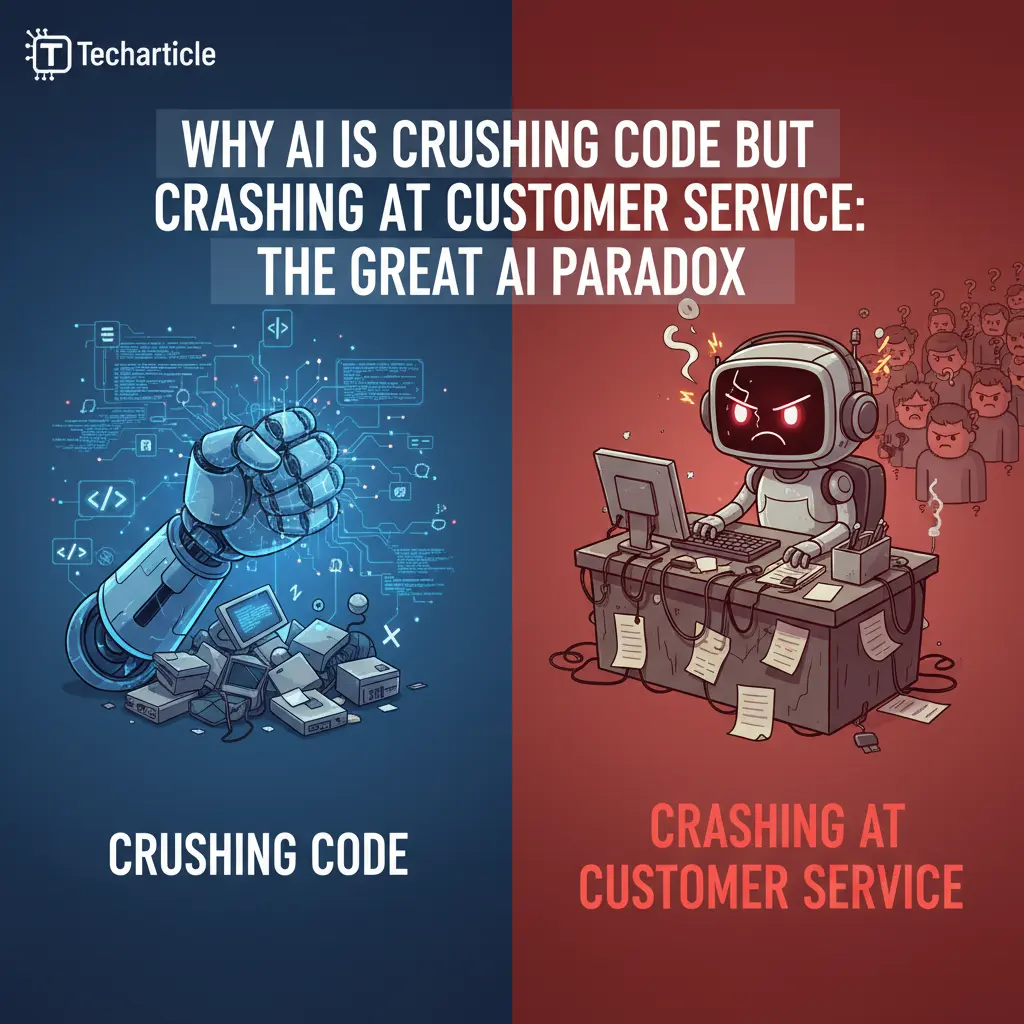
Walk into any tech company today, and you’ll witness something remarkable. Developers are writing code by simply describing what they want. AI assistants complete entire functions before fingers finish typing. What took weeks now takes hours.
But here’s what nobody’s telling you. While AI has revolutionised one slice of business operations, the rest remains stubbornly human. This isn’t a story about robots taking over. It’s about understanding where AI truly works and where it spectacularly fails, in short, the great AI paradox.
The Coding Miracle That Actually Happened
In early 2026, the numbers tell a story that seemed impossible just two years ago. According to MIT Technology Review, AI now writes as much as 30% of Microsoft’s code and more than a quarter of Google’s code. GitHub reported something even more striking. They saw developers merging 43 million pull requests each month in 2025, which represents a 23% jump from the previous year.
This isn’t hype anymore. It’s reality.

Developers are using what’s called “vibe coding” now. Instead of writing every line manually, they describe what they need in plain English. The AI fills in the details. Think of it like having a senior developer sitting next to you, anticipating your next move.
Stack Overflow’s 2025 Developer Survey found that 65% of developers now use AI coding tools at least weekly. Moreover, these aren’t just autocomplete features anymore. Modern AI tools analyze entire code bases, edit across multiple files, fix bugs, and even generate documentation explaining how everything works.
The transformation happened faster than anyone predicted. In 2022, AI coding tools could barely autocomplete a line. By 2024, they could handle complex functions. Now in 2026, autonomous AI agents can take a high-level plan and build entire programs independently.
But here’s where the story gets interesting. While coding experienced this dramatic shift, the rest of the business learned a harsh lesson.
When the Magic Failed: The Salesforce Story
The first concerns Salesforce, the enterprise software giant that has been among the most aggressive adopters of AI in customer-facing operations. About a year ago, CEO Marc Benioff announced that AI agent deployment had enabled the company to reduce its support staff from 9,000 to approximately 5,000. The future had arrived.
Then reality intervened.
Reports from late 2025 and early 2026 indicate that the company is now reducing its reliance on AI due to a comprehensive failure. The AI agents displayed what internal reports called “high variance in responses”. That’s corporate speak for confidently giving wrong answers.
They suffered from “instruction dropping”. In sequences longer than eight steps, the models would simply omit some steps. They exhibited “drift”, losing focus on their primary tasks when users asked unexpected questions.
Major customers complained that AI-driven support took longer to resolve issues than the old search function it replaced. Think about that. The AI was actually slower than the system it was meant to improve.
Salesforce is now pivoting to what it calls “deterministic automation”. Translation? They’re going back to rigid, rule-based scripting. The company that fired thousands of people to embrace AI is now admitting, in corporate language that barely disguises the embarrassment, that they were “more confident” than the technology warranted.
According to a Salesforce benchmark study published in May 2025, while 58% of single-turn questions were answered successfully, only 35% of multi-turn customer support tasks were resolved end-to-end. The failures were systematic. Context loss, slow responses, hallucinated actions, and no audit safeguards.
This wasn’t an isolated incident. In February 2026, approximately $2 trillion in market capitalization evaporated from the software sector as AI agents threatened core SaaS business models. Atlassian dropped 35% after showing an enterprise seat count declining for the first time ever. Salesforce fell 28% despite revenue growth.
The lesson? AI works brilliantly in narrow, well-defined domains like code generation. But throw it into the messy, unpredictable world of human customer service, and it stumbles badly.
Why Coding Succeeded Where Customer Service Failed
The difference comes down to three things.
First, code is deterministic. When you write a function, it either works or it doesn’t. You can test it immediately. There’s no ambiguity. Customer conversations, on the other hand, are unpredictable. People jump between topics, use unclear language, and expect the system to understand context from three exchanges ago.
Second, code has clear rules. Python doesn’t suddenly change its syntax based on mood. Java doesn’t need emotional intelligence. But customer service requires reading between the lines, understanding frustration, and knowing when to escalate to a human.
Third, code forgives iteration. A developer can run their code a hundred times, fix bugs, and improve it. But a customer who gets a wrong answer three times in a row will never trust your system again. Therefore, the margin for error in customer-facing AI is much smaller.
Anthropic Recent Development and Why It Is Important
As of early 2026, Anthropic has established itself as a leading AI company focusing on safe, enterprise-grade AI. The company is driven by the rapid development of its Claude model family, particularly Claude Opus 4.6, which was released in February 2026.
What makes this significant? Opus 4.6 is designed for high-stakes, long-running tasks. It handles complex coding, financial analysis, and document processing with greater reliability. This represents a shift from simple chatbots to what the industry calls “vibe working”. AI now takes on multi-step, complex workflows rather than just answering simple queries.
Anthropic introduced Claude Cowork, an agent-based system that allows AI to execute complex, multi-step workflows like coding and legal review with user consent. This triggered a major market shift that investors dubbed the “SaaSpocalypse”. Investors sold off traditional software-as-a-service stocks, anticipating that AI agents would replace, rather than just enhance, human-staffed software services.
The company also created and open-sourced the Model Context Protocol. This is a universal standard for connecting AI applications to external systems like databases and code repositories. In addition to this, it allows Claude to securely access real-time data, making it more useful than models relying on static training data.
In February 2026, Anthropic raised $30 billion in a Series G funding round, achieving a $380 billion valuation. The company is experiencing 10x annual revenue growth, largely driven by enterprise adoption. Moreover, Anthropic opened a Bengaluru office to target the Indian market, which is the second-largest for Claude.ai.
Why does this matter? Anthropic’s focus on safety, interpretability, and reducing AI-driven risks makes it a preferred choice for regulated industries like finance and law. With 80% of its business coming from enterprise, these updates focus on reliability and security. AI is becoming a boardroom necessity rather than a novelty.
The Real Picture: Where AI Works and Where It Doesn’t
Let’s be honest about what we’re seeing in early 2026.
AI excels at repetitive, pattern-based work. It can write boilerplate code, generate marketing copy variations, transcribe meetings, and analyse structured data. These tasks follow predictable patterns. AI learns those patterns and replicates them efficiently.
But AI struggles with anything requiring judgment, creativity, or deep context. It can’t navigate office politics. It can’t understand why a customer is really upset when they say they’re “fine”. It can’t make strategic decisions that balance competing priorities.
According to Capgemini’s UK CTO Steven Webb, organizations will need strong traceability, provenance controls, and automated assurance mechanisms to ensure safety and security as AI code generation becomes mainstream. The technology has potential, but trust remains a major concern.
Think about it this way. AI can draft a legal document based on templates. But it can’t advise you on whether to settle or fight a lawsuit. That requires understanding risk tolerance, company culture, and long-term strategic implications. Moreover, it requires the kind of judgment that comes from years of experience, not pattern matching.
The Jobs That Will Continue to Matter
So what does this mean for you? Which jobs remain valuable in an AI-saturated world?

Here are eight job roles that will continue to be in high demand even after the AI surge.
1. AI Ethics and Governance Specialists
These professionals ensure AI systems are fair, compliant, and aligned with regulatory standards. They create governance frameworks, mitigate bias, and provide oversight. Salaries typically range from £95,000 to £225,000.
As organizations increasingly rely on AI, someone needs to ask the hard questions. Is this system discriminating? Are we protecting user privacy? What happens when the AI makes a mistake? Therefore, these roles become more critical, not less, as AI expands.
2. Strategic Decision Makers and Business Leaders
AI can provide data and recommendations. But it can’t make the final call on major business decisions. Leaders need to weigh competing priorities, understand organizational politics, and make judgment calls with incomplete information.
This is inherently human work. Because strategic thinking requires understanding context that AI simply can’t grasp. What worked for your competitor might not work for you. Your company culture, your market position, and your long-term vision all matter.
3. Creative Professionals and Content Strategists
AI can generate content. But it can’t create truly original ideas. It recombines existing patterns. Human creativity comes from lived experience, cultural context, and the ability to connect disparate ideas in new ways.
Moreover, someone needs to decide what message resonates with your audience. What story will your brand tell? How do you stand out in a crowded market? These questions require human insight.
4. Complex Problem Solvers and Systems Thinkers
When things go wrong in unexpected ways, you need humans who can diagnose the real problem. AI works great when issues fit known patterns. But novel problems require creative thinking and the ability to see connections across different domains.
For instance, if sales are down, is it a marketing problem? A product problem? A pricing problem? Or something else entirely? Figuring that out requires systems thinking that AI hasn’t mastered.
5. Relationship Managers and Client-Facing Roles
People still want to work with people, especially for high-value transactions. B2B sales, executive recruiting, financial advising for high-net-worth individuals—these all require building trust and understanding nuanced needs.
AI can support these roles with data and suggestions. But it can’t replace the human connection that closes major deals or retains important clients. Because relationships are built on empathy, shared experience, and mutual understanding.
6. Specialized Technical Roles
While AI can write basic code, specialized technical work remains firmly in human hands. Cybersecurity experts who understand how attackers think. Cloud architects who design resilient systems. Data engineers who build pipelines that handle edge cases.
In addition to this, these roles require deep expertise and the ability to anticipate problems before they occur. AI can assist, but it can’t replace the judgment that comes from years of experience.
7. Healthcare and Caregiving Professionals
Medicine requires more than pattern matching. Doctors need to understand patients as whole people, not just collections of symptoms. Nurses provide emotional support alongside medical care. Mental health professionals build therapeutic relationships.
AI can support diagnosis and treatment planning. But healthcare fundamentally depends on human compassion and judgment. Therefore, these roles remain irreplaceable.
8. Educators and Training Specialists
As AI transforms work, someone needs to help people adapt. Trainers who can teach new skills. Educators who can inspire learning. Mentors who can guide career development.
Moreover, effective teaching requires understanding how different people learn, adapting to their needs, and providing encouragement when they struggle. AI can deliver content, but it can’t replace a great teacher.
What This Means for Your Career
The pattern is clear. AI is transforming work that’s predictable and rules-based. Coding fell into that category, which is why the transformation happened so fast.
But most business work isn’t like that. It requires judgment, creativity, relationship-building, and navigating ambiguity. These remain firmly human domains.
So what should you do?
First, learn to work with AI. Don’t fight it. The developers who embraced AI coding tools became more productive. Those who resisted fell behind. The same will happen in other fields.
Second, focus on developing uniquely human skills. Strategic thinking. Emotional intelligence. Creative problem-solving. These are the capabilities AI can’t replicate.
Third, specialize in areas where human judgment matters. The more your work requires understanding context, building relationships, or making nuanced decisions, the more valuable you become.
The Future Is Hybrid, Not Binary
The story of AI in 2026 isn’t about humans versus machines. It’s about finding the right division of labour.
AI revolutionized coding because coding fits its strengths perfectly. Clear rules, immediate feedback, and the ability to test and iterate. But the Salesforce failure shows what happens when you apply AI to work that requires human judgment and adaptability.
The companies succeeding with AI aren’t the ones trying to replace humans entirely. They’re the ones figuring out which 10% of work AI can handle brilliantly, and focusing human talent on the 90% that still requires human touch.
According to Microsoft’s chief product officer for AI experiences, the future isn’t about replacing humans, it’s about amplifying them. AI agents are set to become digital coworkers, helping individuals and small teams accomplish more. Organizations that design for people to learn and work with AI will get the best of both worlds.
This is the real revolution. Not AI replacing everything, but AI handling the predictable parts while humans focus on work that requires judgment, creativity, and human connection.
The question isn’t whether AI will transform your industry. It will. The question is whether you’ll focus on developing the skills that remain uniquely valuable when the dust settles.
Because the 10% revolution in coding was just the beginning. The next phase will be about figuring out which other 10% chunks AI can handle, and making sure humans remain essential for the 90% that truly matters.