
I watched my colleague break down in the bathroom last Tuesday. She wasn’t crying about a breakup or a family emergency. She was staring at her phone, reading an article about GPT-5’s capabilities, whispering: “I’ve spent fifteen years becoming an expert at this, and now…”
I get it. We all do.
Because here’s the uncomfortable truth we’re all dancing around at our standing desks and Zoom calls: the ground beneath our feet isn’t just shifting—it’s liquefying. In this new reality, adaptability isn’t a soft skill; it’s the very art of staying upright while everything moves.
The Extinction Event Happening in Slow Motion
You know what’s wild? If our ancestors hadn’t figured out adaptability, we’d literally still be swinging from trees with ponytails on our backs, picking bugs off each other for lunch. They looked at fire—something that had always meant run away—and thought, “What if we could use this?” That cognitive leap, that ability to adapt their entire worldview, is why you’re reading this on a device instead of foraging for berries.
But here’s where it gets interesting: the rate of change our ancestors faced over millennia, we’re experiencing in months.
Remember March 2020? You were probably sitting in an office, complaining about commute traffic, planning which conference to attend next quarter. Then suddenly—instantly—you were setting up a makeshift workspace in your bedroom, learning Zoom etiquette, figuring out how to look professional from the waist up while wearing pyjama pants. Your entire professional reality restructured in days.
And just when you adapted to that? Hybrid work. Return-to-office mandates. Then back to hybrid. Then AI tools that can do in thirty seconds what used to take you three hours.
The rules keep changing. And they’re changing faster.
The Exhaustion Is Real (And You’re Not Imagining It)
Let’s talk about why you’re so damn tired.

It’s not just the workload. It’s not just the meetings that could’ve been emails. It’s the constant recalibration. You finally master one system, one workflow, one skill set—and then the entire landscape shifts. You’re not running a race; you’re running a race where someone keeps moving the finish line and occasionally changes the direction entirely.
I have a friend—a brilliant engineer, ten years at a top tech company—who spent his evenings for six months learning a specialised framework. Got certified. Built his expertise. Then his company pivoted to a completely different tech stack. All that time, all that learning, suddenly adjacent to irrelevant.
But here’s what he did: he didn’t rage-quit. He didn’t spiral into “the world is unfair” paralysis. He took a weekend to feel frustrated (because that’s valid), then started learning the new stack. Why? Because he understood something crucial: the skill isn’t knowing one framework. The skill is being able to learn any framework.
That’s adaptability. Not the ability to know everything, but the capacity to become whatever the moment requires.
The Three Modes of Modern Adaptability
Let’s break this down to what actually matters in your life right now.
Mode One: Professional Evolution
You’re watching AI tools proliferate like weeds. ChatGPT, Midjourney, Copilot, Claude—each one potentially automating something you spent years learning to do well. And here’s the fork in the road where people split:
Some people see these tools and think, “This is coming for my job.” They resist, they avoid, they hope it’ll go away.
Others think, “This is going to make someone incredibly valuable at their job. Why not me?”
The person who learns to use AI tools effectively doesn’t just keep their job—they become indispensable. They’re not competing with AI; they’re augmented by it. They’re producing at 10x their previous capacity while their resistant colleagues are still hand-crafting what could be generated in seconds.
But this requires letting go of something painful: the identity you’ve built around doing things a certain way. The pride of “I do everything from scratch.” The comfort of mastered routines.
Adaptability here means admitting: I don’t know this yet, and that’s fine. The smartest person in the room isn’t the one who knows everything—it’s the one who can learn anything.
Mode Two: Work-Life Architecture
Remember when “work-life balance” meant clear boundaries? You went to an office, you came home, and work stayed at work?
Now? Your bedroom is your office. Your office might be a coffee shop. Or maybe you’re back in a building three days a week, except those days keep changing. Maybe it’s Monday-Wednesday, maybe Tuesday-Thursday, maybe your team doesn’t align with finance’s schedule so meetings are chaos.
And if you’re in that sandwich generation—suddenly responsible for aging parents while raising young kids while climbing the career ladder—adaptability isn’t optional. It’s survival.
I know a director-level executive who became a father at thirty-eight. He told me: “I had this entire identity built around being available 24/7, staying late, being the first one online in the morning. Then my daughter was born, and none of that worked anymore. I had to completely reconstruct what ‘successful professional’ looked like.”
He adapted. Started blocking calendar time for daycare pickup (non-negotiable). Became ruthlessly efficient with his hours. Learned to say no to the 15% of work that generated 2% of value. His productivity actually increased because adaptability forced him to optimize in ways comfort never would have.
Mode Three: Relationship Dynamics
Here’s one they don’t talk about enough in corporate wellness webinars: adapting who you are in relationships while staying true to yourself.
Going from bachelor life to committed partnership to parenthood—each phase requires shedding old identities and growing new ones. The person who can’t adapt their social patterns, their spontaneity, their self-centred decision-making? They struggle. Or they fail.
But the person who can hold multiple truths simultaneously—”I am independent and I am deeply connected,” “I have personal goals and I have family responsibilities”—they don’t just survive these transitions. They thrive in them.
Why We’re Not Taught This (And Why That’s Changing)
Here’s what’s infuriating: we spend twelve-plus years in school learning calculus and the periodic table, but almost zero time learning how to adapt. We’re not taught:
- How to sit with uncertainty without panicking
- How to update beliefs when evidence changes
- How to rebuild identity after a professional shift
- How to regulate emotions during turbulence
We’re taught answers, not the process of finding answers when everything changes.
But—and this is crucial—companies are finally noticing. LinkedIn’s research shows adaptability has been the #1 most sought-after skill for the past several years. Not coding. Not project management. Adaptability. Because organisations have realised: you can teach someone Python, but you can’t teach someone to stop rigidly clinging to “the way we’ve always done it.”
Research from Martin et al. (2015) tracked high school students and found that those who demonstrated adaptability had significantly lower failure rates than their less adaptive peers. It’s not about intelligence. It’s not about privilege. It’s about the ability to evolve.
Charles Darwin said it 130 years ago: “It is not the strongest or the most intelligent who will survive but those who can manage change.”
And over 2,000 years before that, Heraclitus nailed it: “The only thing that is constant is change.”
The wisdom isn’t new. But the pace is. That’s the difference. That’s why it matters more now than ever.
The Muscles You Need to Build
So how do you actually do this? How do you become more adaptable when your instinct is to find solid ground and cling to it?
Hold things loosely. The tighter you grip your plans, your expectations, your image of how things “should” be—the more it hurts when reality diverges. Practice the art of strong opinions, weakly held. Be committed to outcomes, flexible on methods.
Stay curious, not furious. When something changes—a new tool, a new process, a new manager with different priorities—your first instinct might be anger or resistance. That’s normal. Feel it. Then ask: “What could I learn here? What might I not be seeing?” Rigidity kills. Curiosity reveals paths through.
Separate uncertainty from danger. Your brain will scream “THREAT!” when things feel unstable. But uncertainty doesn’t equal danger. You can be uncomfortable and still be safe. You can be in transition and still be okay. Remind yourself: “I don’t know what’s next and I’ve survived every previous unknown.”
Find your anchors. Even in chaos, there are constants. Your morning coffee ritual. Your Friday night movie with your partner. The colleagues who make you laugh. Your evening walk. These anchors don’t stop the world from changing—they remind you that not everything is in flux.
Reframe failure as data. Every attempt that doesn’t work is information about what to try next. The person who tries something new and fails is learning. The person who refuses to try anything is stagnating. Adaptability requires permission to be bad at things initially.
The Secret Benefit Nobody Talks About
Here’s what I’ve noticed about the most adaptable people I know: they’re weirdly calm.
Not because their lives are easy or stable—they’re not. But because they’ve internalised a powerful truth: I can handle whatever comes. Not because they have all the answers, but because they trust their ability to find answers. Or to find new questions when the old ones stop working.
That confidence—that deep-down knowledge that you can evolve, pivot, learn, adjust—it’s like having a superpower. It transforms anxiety into curiosity. It turns obstacles into puzzles. It makes you the person everyone wants on their team because when things go sideways (and they will), you don’t freeze or panic. You adapt.
And paradoxically, the more adaptable you become, the more grounded you feel. Because you’re not dependent on external circumstances staying the same. Your stability comes from within—from knowing you can dance with whatever comes.
The Bottom Line
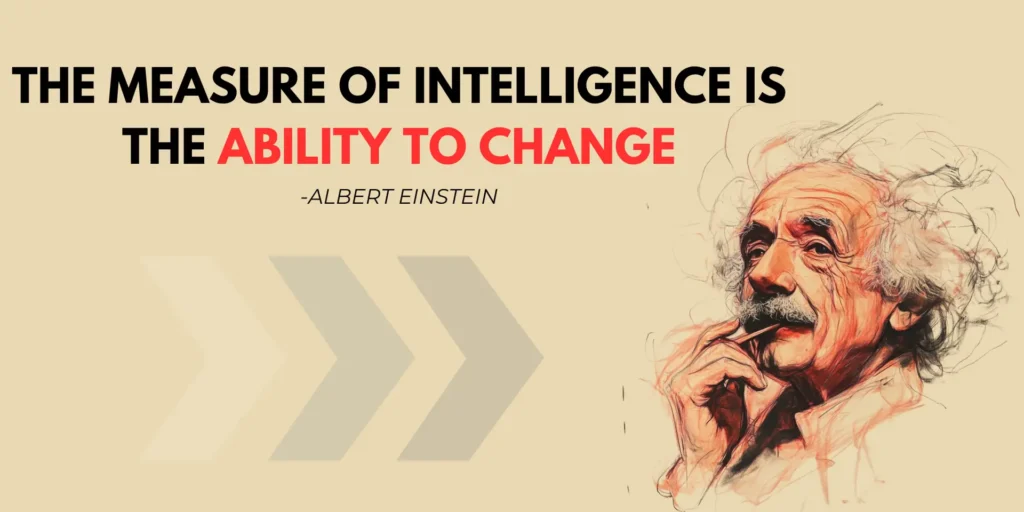
We’re living through a compression of change that’s unprecedented in human history. AI is restructuring industries in months. Work models are fluid. Career paths are non-linear. The skills that matter today might be automated tomorrow.
You can rage against this. You can wish for simpler times. You can cling to the way things were.
Or you can adapt.
Not because it’s easy. Not because it’s comfortable. But because it’s the only way forward.
The people who will thrive in the next decade aren’t the ones with the most specialised knowledge or the most prestigious credentials. They’re the ones who can learn fast, pivot gracefully, and rebuild themselves as many times as necessary.
They’re the ones who understand: adaptability isn’t just a nice-to-have skill for handling change.
Adaptability is the skill that determines whether you shape the future or get shaped by it.
So the next time you’re staring at a new AI tool, or another restructure announcement, or a sudden shift in your personal life—take a breath. Feel the resistance. Then ask yourself:
Who do I need to become to thrive here?
Because you can. You absolutely can. The only question is: will you?
If you’re someone who is serious about his/her career and want to learn how to effectively use ChatGPT to improve your daily productivity at work, then you might want to read this article:
Work Smarter, Not Harder: 8 ChatGPT Secrets to Save 10+ Hours Like a Pro
Here are some more posts that are related to career and personal development, take a look:
Top 5 AI Trends I’m Looking Out for in 2025
The 10 Best Soft Skills to Learn Now – They’ll Help You Forever
Brain Rot: The Silent Epidemic Stealing Your Focus and Willpower
The Shocking Truth: 87% of People Don’t Know Who They Are Outside of Work. Do You?